PRP & PRF Regenerative
Treatments in Lutz, FL
PRP and PRF harness concentrated components from your own blood as part of a personalized regenerative treatment strategy.
At Rejuv Timeless Health & Aesthetics, these treatments may be used to support skin rejuvenation, hair and scalp concerns, sexual wellness, and selected musculoskeletal concerns.
The goal is not simply to “do PRP.” We consider what you are trying to improve, the tissue being treated, your individual health picture, and whether PRP, PRF, another treatment, or a combination approach makes the most sense.
What Are PRP and PRF?
PRP stands for Platelet-Rich Plasma. PRF stands for Platelet-Rich Fibrin.
Both begin with a small amount of the patient's own blood. The blood is processed to concentrate selected components that can then be used as part of a targeted treatment.
Platelets contain signaling proteins and growth factors involved in the body's normal tissue-repair processes.
PRP is a platelet-rich plasma preparation that may be injected or combined with certain procedures depending on the treatment goal.
PRF is prepared differently and includes a fibrin matrix that can influence how platelet-associated components are retained and released.
The practical difference matters because PRP and PRF are not interchangeable in every situation. The preparation we consider depends on what we are treating, how it will be used, and the individual patient.
PRP vs. PRF:
What's the Difference?
PRP
Platelet-Rich Plasma- Plasma-based platelet concentrate
- Prepared from the patient's own blood
- Preparation methods may vary
- May be injected or incorporated into certain procedures depending on the treatment goal
PRF
Platelet-Rich Fibrin- Prepared from the patient's own blood
- Contains a fibrin matrix
- Prepared differently from PRP
- The fibrin structure can influence how platelet-associated components are retained and released
Neither is automatically “better.”
The appropriate preparation depends on what we are treating, how the preparation will be used, patient-specific considerations, and the overall treatment strategy.
One Regenerative Modality.
Different Applications.
Skin Rejuvenation
PRP/PRF may be incorporated into skin-rejuvenation plans designed to support collagen-focused treatments and improve overall skin quality.
Common goals may include:
- skin texture
- tone
- collagen support
- overall skin quality
- facial rejuvenation
PRP/PRF may be used with microneedling or microchanneling, as a targeted application when appropriate, or as part of a broader skin-treatment plan.
Hair & Scalp
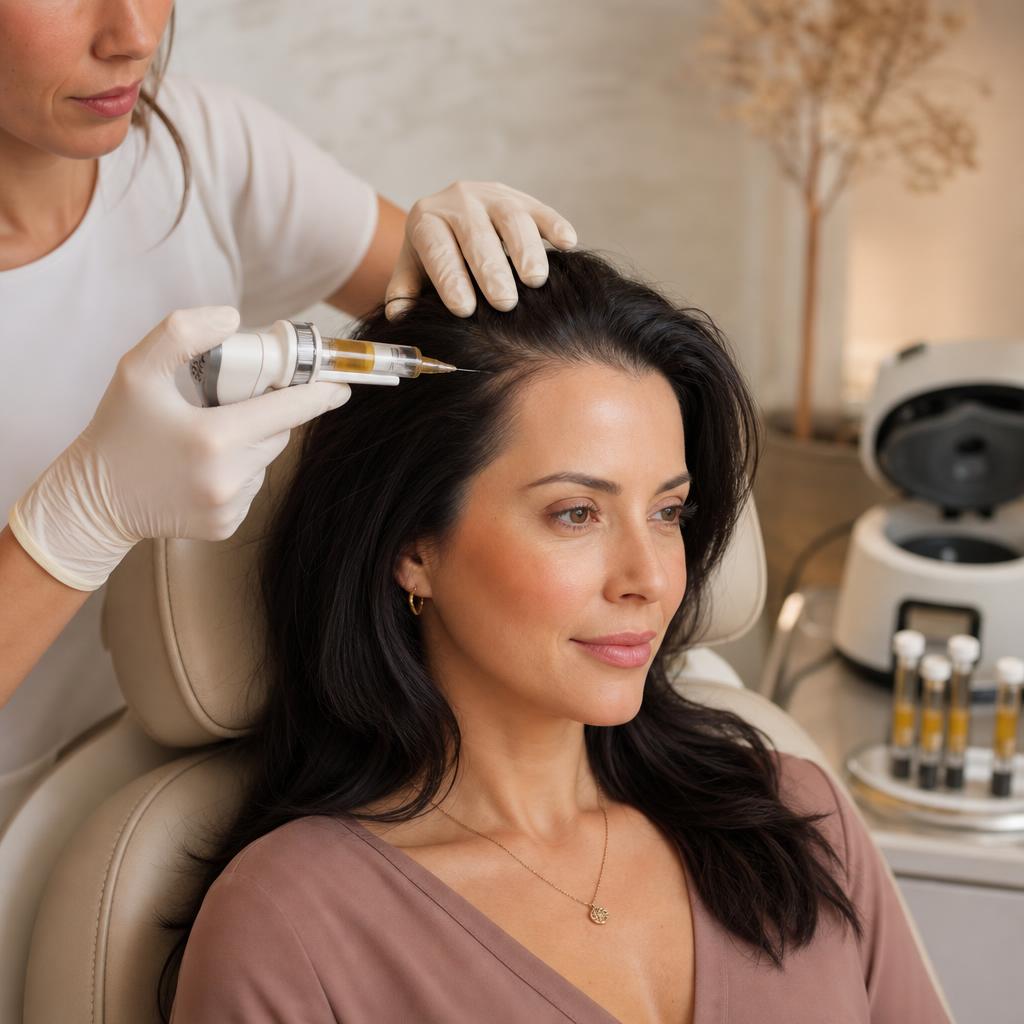
PRP/PRF may be considered for appropriate patients concerned about hair thinning, density, or overall hair and scalp health.
Because hair loss can have many causes, the first step is understanding the pattern and potential underlying contributors.
Evaluation may consider:
- pattern and type of hair loss
- hormonal, nutritional, or metabolic factors
- medications and health history
- scalp and hair characteristics
- whether PRP/PRF has an appropriate role
P-Shot & O-Shot
PRP is used in certain sexual-wellness procedures commonly referred to as the P-Shot and O-Shot.
These treatments may be considered within a broader sexual-wellness plan for concerns involving erectile function, sexual performance, arousal, sensation, vaginal wellness, or sexual response.
Because sexual-health concerns can have hormonal, vascular, neurologic, medication-related, psychological, pelvic-floor, metabolic, or other contributors, treatment begins with understanding the individual.
Joints, Tendons & Soft Tissue
PRP/PRF may be considered in selected musculoskeletal treatment plans involving joint, tendon, ligament, or soft-tissue concerns.
Patients may be seeking help with concerns involving:
- joints
- tendons
- ligaments
- soft tissue
- recovery
- physical function
Appropriate evaluation helps determine the underlying concern and whether PRP/PRF has a reasonable role within the treatment plan.
Explore PRP Breast Rejuvenation
A PRP Breast Lift is a nonsurgical, consultation-led option for selected patients seeking subtle improvement in breast and décolleté skin appearance. It is not a substitute for surgical lifting or augmentation.
LEARN ABOUT PRP BREAST REJUVENATIONNOT SURE WHICH APPROACH FITS YOUR GOALS?
PRP and PRF can be used very differently depending on what you want to address. Tell us whether your concern is skin, hair, sexual wellness, a joint or injury, or something else, and our team can help determine an appropriate next step.
Regenerative Skin
Rejuvenation
PRP/PRF can be incorporated into skin-treatment plans in several ways depending on the patient's goals.
It may be discussed alongside microneedling or microchanneling, used as a targeted application when clinically appropriate, or incorporated into a broader rejuvenation strategy focused on collagen, texture, tone, and overall skin quality.
PRP/PRF and microneedling are not the same treatment.
Microneedling creates controlled microchannels in the skin and initiates a healing response. PRP/PRF is the biologic preparation that may be incorporated into the treatment strategy. They may be used together, but they remain distinct components of care.

Hair Restoration Starts
With Understanding
Hair Loss
Hair thinning has many potential causes. The right treatment starts with understanding yours.
Changes in hair density may be influenced by genetics, hormones, nutrition, metabolic health, medications, stress, health conditions, scalp factors, and other contributors.
For appropriate patients, PRP/PRF may be incorporated into a broader hair-restoration strategy designed around the type of hair loss and the individual's overall health picture.
It is not a one-size-fits-all treatment for every form of hair loss, which is why evaluation matters.

A Regenerative Option
Within a Broader Sexual-Wellness Strategy
PRP-based procedures may be incorporated into sexual-wellness treatment plans for both men and women.
The P-Shot and O-Shot are PRP-based procedures that may be discussed for concerns involving sexual function, performance, sensation, arousal, vaginal wellness, or sexual response.
But sexual wellness is rarely about one treatment alone.
Hormones, circulation, medications, metabolic health, pelvic-floor factors, neurologic factors, stress, and other aspects of health may influence sexual function.
At Rejuv, PRP-based sexual-wellness treatments are considered within that larger clinical picture.
A Regenerative Approach to
Selected Musculoskeletal Concerns
Joint, tendon, ligament, and soft-tissue concerns can affect how you move, recover, train, and function in everyday life.
PRP/PRF uses autologous biologic material as part of a regenerative approach that may be considered for selected musculoskeletal concerns after appropriate evaluation.
The first question is not simply:
“Can PRP be injected here?”
The more important question is:
“What is causing the problem, and what treatment strategy makes sense?”
Evaluation may consider the diagnosis, tissue involved, severity and duration of the concern, health history, previous treatment, functional goals, and whether PRP/PRF or another approach has an appropriate role.

Not All PRP Treatments
Are Identical
“PRP” describes a category of platelet-rich preparations rather than one universally identical product. How the blood is collected, processed, prepared, and ultimately used can affect the final preparation and treatment strategy.
That is why provider evaluation, preparation, application, and clinical judgment matter.
Preparation Factors
- Collection volume
- Processing method
- Centrifugation approach
- Final preparation
Biological Factors
- Platelet concentration
- Cellular composition
- Patient-specific biology
Clinical Factors
- Activation/application approach
- Treatment location
- Injection/application technique
Autologous Treatment
PRP and PRF are autologous, meaning the material used for treatment originates from your own blood.
A small amount of blood is collected, processed to create the selected PRP or PRF preparation, and then used as part of the targeted treatment.
Because the preparation comes from the individual patient, PRP/PRF is fundamentally different from treatments involving manufactured medications or synthetic materials.
Autologous does not mean risk-free. Appropriate candidacy, preparation, technique, and medical oversight still matter.

PRP Is One Tool —
Not All of Regenerative Medicine
Regenerative medicine is broader than PRP or PRF alone.
At Rejuv, we look at the individual rather than defining regenerative care by a single procedure.
Depending on the patient's goals and health picture, a broader strategy may consider factors such as metabolic health, hormone status, body composition, nutrition, recovery, lifestyle, peptide-based therapies when appropriate, and other medically appropriate treatments alongside regenerative procedures.
PRP/PRF is one regenerative modality that may be incorporated when it has an appropriate role.
What Does a PRP / PRF
Treatment Involve?
We begin by understanding the concern, your goals, health history, and whether PRP/PRF has an appropriate role in your treatment plan.
A small amount of blood is drawn, similar to a routine laboratory blood draw.
The blood is processed according to the treatment protocol to create the selected PRP or PRF preparation.
The preparation is applied or administered to the targeted treatment area according to the individualized treatment plan.
Treatment time, number of sessions, recovery, aftercare, and the exact procedure vary depending on how PRP/PRF is being used.
Real Expertise.
Real Answers.
PRP stands for Platelet-Rich Plasma. It describes a preparation created from a small sample of your own blood, which is processed to separate and concentrate the platelets from the red and white blood cells. Platelets are best known for their role in clotting, but they also contain signaling proteins and growth factors involved in normal tissue-repair processes.
In regenerative medicine, we use this concentrated preparation as part of a treatment strategy, applying it to targeted areas with the intent of working with the body's natural biological signaling. It is one modality used within a broader, individualized plan.
PRF stands for Platelet-Rich Fibrin. Like PRP, it is an autologous preparation derived from your own blood, but it is processed differently—typically at a lower centrifugation speed and without the addition of an anticoagulant. This specific processing method preserves a fibrin matrix, which acts as a scaffold that can trap the platelets.
The fibrin structure is thought to influence how platelet-associated signaling factors are retained and released over time after application. It represents another way to prepare and deliver concentrated biological material, and it is selected based on the specific clinical application and treatment goals.
The primary differences lie in the preparation method and the physical properties of the final product. PRP is processed to create a liquid plasma concentrate, often involving higher centrifugation speeds and the use of an anticoagulant to prevent premature clotting. PRF is processed at lower speeds without an anticoagulant, resulting in a preparation that forms a gel-like fibrin scaffold.
They are not interchangeable; the choice between them depends on the specific treatment, the tissue being targeted, how the material needs to be handled during the procedure, and the provider's overall clinical strategy for the patient.
Neither preparation is automatically “better” than the other. They are simply different preparations that behave differently when applied. Because PRF contains a fibrin matrix, it may release signaling factors differently, but that does not mean it is universally superior for every application.
PRP's liquid nature and specific concentration profile make it the appropriate choice for certain treatments where a fluid preparation is necessary. The appropriate preparation depends entirely on what we are treating, how it will be used, patient-specific considerations, and the overarching treatment strategy developed during your clinical evaluation.
Depending on the individual patient and a thorough evaluation, PRP and PRF may be incorporated into treatment plans for several different areas. These can include skin rejuvenation approaches (often in combination with other modalities), hair and scalp concerns where appropriate, sexual wellness procedures (such as those commonly referred to as the P-Shot and O-Shot), and selected musculoskeletal or joint concerns.
Candidacy is determined on a case-by-case basis, and we do not imply that PRP or PRF is an appropriate or necessary treatment for every patient presenting with these concerns.
Yes, PRP or PRF can be incorporated into a skin-rejuvenation strategy. It may be used in conjunction with treatments like microneedling or microchanneling, or applied in targeted areas as part of a broader plan focused on collagen support and overall skin quality.
When considering it for texture concerns or facial rejuvenation, it is typically viewed as one component of a comprehensive approach. The exact protocol depends on the specific skin concern and the patient's individual goals.
PRP and PRF may be appropriate for certain patients and can be incorporated into a broader strategy for specific forms of hair thinning or loss. However, hair loss is a complex medical concern with many potential causes, including hormonal imbalances, nutritional deficiencies, metabolic factors, and genetic predispositions.
A thorough evaluation is necessary to understand the pattern and potential underlying factors. We do not present PRP or PRF as an automatic hair-growth treatment, nor do we guarantee results or imply that it works for every form of alopecia.
The P-Shot and O-Shot are specialized procedures that use a PRP-based preparation as part of a sexual-wellness treatment strategy. Following an appropriate evaluation of sexual health concerns, the autologous preparation is administered to specific areas.
It is important to emphasize that sexual concerns may involve vascular, hormonal, neurologic, psychological, or medication-related factors. Therefore, treatment deserves an individualized evaluation to determine whether a PRP-based procedure is an appropriate component of the overall care plan, rather than viewing it as a guaranteed standalone solution.
PRP and PRF may be considered in selected musculoskeletal applications as part of an individualized treatment approach. Potential treatment areas may involve appropriate joints, tendons, ligaments, or soft-tissue concerns.
However, we do not claim that PRP "heals" injuries, "regrows cartilage," or "repairs torn tendons." The appropriateness of the procedure depends entirely on the specific diagnosis, the tissue involved, the severity of the condition, the patient's overall health history, and realistic treatment goals established during a comprehensive medical evaluation.
There is no fixed or universal number of treatments that applies to every patient. The recommendation depends heavily on the condition being treated, its severity, the treatment area, the patient's individual biological characteristics, and the specific treatment goals.
Skin applications, hair restoration strategies, and musculoskeletal treatments all follow different potential schedules. Your provider will outline an initial plan during your consultation and will reassess progress over time rather than guaranteeing a preset series of treatments before understanding how you respond.
Biologic responses and treatment goals differ significantly between patients and applications, and PRP should never be presented as an instant-result procedure. Because regenerative approaches rely on working with the body's normal repair signaling environment, any potential changes occur gradually.
The timeline for evaluating progress depends on whether the treatment is directed toward skin quality, hair concerns, musculoskeletal issues, or sexual wellness. Your provider will discuss realistic expectations and follow-up timelines based on your specific individualized treatment plan.
The experience following a procedure varies depending on how the preparation is used. When combined with skin resurfacing or microneedling, patients may experience temporary redness, warmth, or sensitivity in the treated area.
Applications for joint, tendon, or sexual wellness concerns may involve localized soreness or specific, temporary activity restrictions. Your provider will discuss exactly what to expect based on the specific treatment planned, including any necessary aftercare instructions and how to manage the recovery period appropriately.
PRP and PRF are autologous, meaning the material originates from your own body. This is fundamentally different from injecting a manufactured synthetic product.
However, describing any procedure as "risk-free" or claiming it is safe simply because it is natural is medically inaccurate. Any procedure involves risks, including but not limited to infection, bleeding, localized pain, or unexpected tissue response. A clinical evaluation is necessary to discuss these risks and determine whether the procedure is appropriate for you.
"PRP" describes a broad category of platelet-rich preparations rather than one universally identical product. The characteristics of the final preparation can differ based on the volume of blood collected, the specific processing method, the centrifugation approach, and the cellular composition of the concentrate.
Furthermore, the provider's evaluation, the application or injection technique, and the integration of the procedure into a comprehensive treatment plan are crucial variables. This is why thorough provider evaluation and careful treatment planning matter significantly more than simply the name of the procedure.
Could PRP / PRF Be
Right for You?
PRP and PRF can serve very different purposes depending on what you are trying to improve.
Tell us what brought you here and our team can help you understand whether PRP/PRF — or another Rejuv treatment — may have an appropriate role.