Compounded GLP-1s in 2026: The FDA 503B Shift
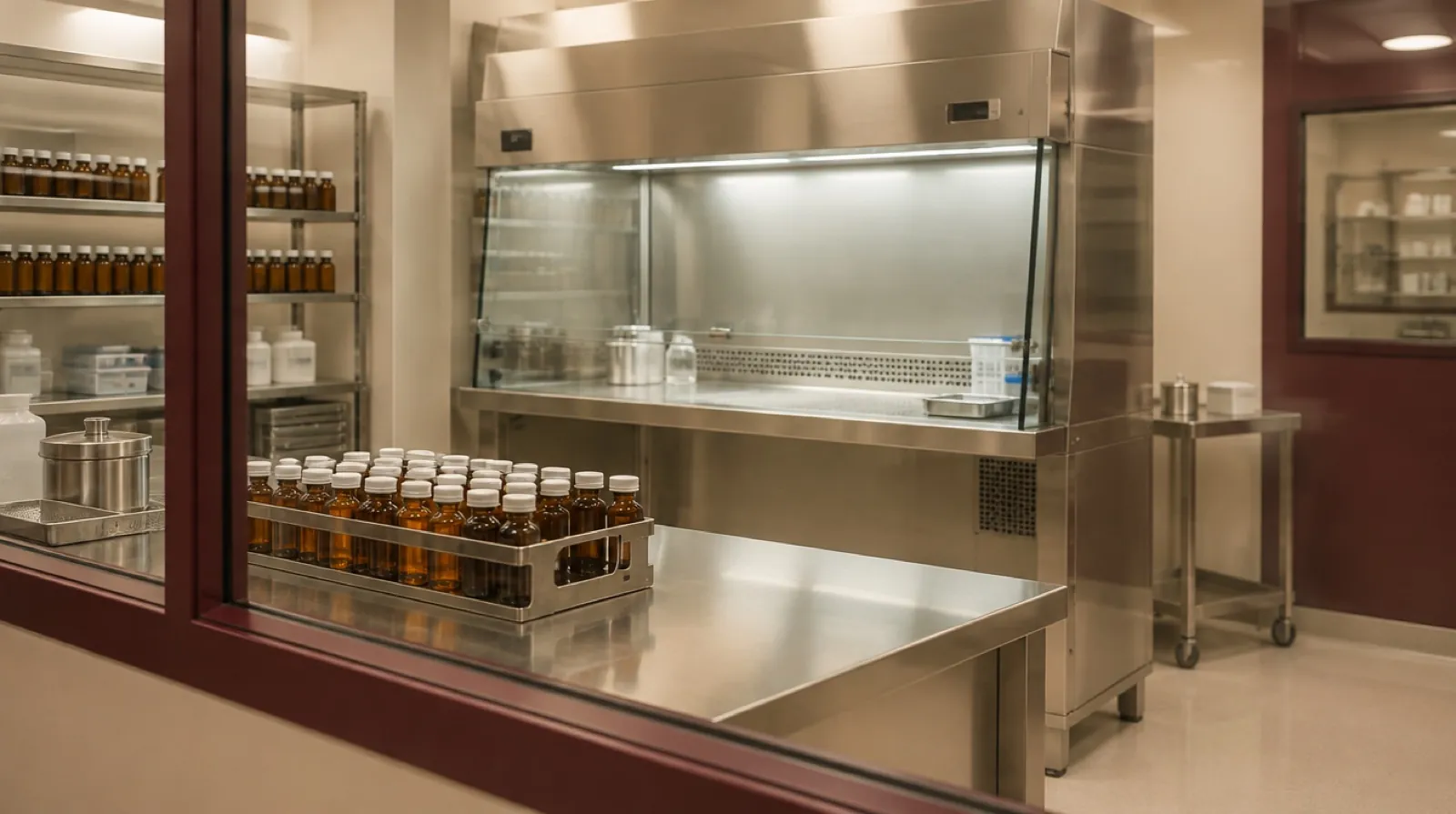
On April 30, 2026, the FDA proposed keeping semaglutide, tirzepatide, and liraglutide off the "503B bulks list." That list decides which raw drug ingredients large compounding facilities may use. If the proposal becomes final, those facilities would generally lose their legal path to make these GLP-1 medicines from bulk powder while the brand-name drugs are available.
This change is real, and it is part of a larger pattern. The national shortages that opened the door to mass compounding ended in December 2024 (tirzepatide) and February 2025 (semaglutide). Since then the FDA has narrowed what compounders may do, warned telehealth sellers about their marketing, and kept counting adverse-event reports.
Here is what has actually happened, what is still pending as of October 21, 2026, and what to ask if you are taking a compounded GLP-1 today.
Table of Contents
What changed in 2026
Three FDA actions matter this year.
March 3, 2026: warning letters to telehealth companies. The FDA announced 30 warning letters to telehealth companies over how they advertised compounded GLP-1 products. The main problems the agency named were claims implying the compounded drug is the same as an FDA-approved product, and branding products with the telehealth company's own name in a way that hides who actually compounded them. The FDA called this the second group of telehealth warning letters since a crackdown on misleading drug ads that began in September 2025.
April 1, 2026: a reminder about "essentially copies." The FDA updated its compounding guidance page to restate the rules. A state-licensed pharmacy may not compound, regularly or in large amounts, drugs that are essentially copies of a commercially available product. Same active ingredient, a similar strength, same route of use: that is a copy, unless the prescriber documents a significant difference for that specific patient. The FDA said that adding an ingredient such as vitamin B12 does not automatically make a semaglutide product different. It also stated that tirzepatide and semaglutide were not on the 503B bulks list or the drug shortage list.
April 30, 2026: the 503B bulks list proposal. The FDA proposed not to include semaglutide, tirzepatide, or liraglutide on the 503B bulks list, saying it found no clinical need for outsourcing facilities to compound them from bulk ingredients. "When FDA-approved drugs are available, outsourcing facilities cannot lawfully compound using bulk drug substances unless there is a clear clinical need," Commissioner Marty Makary said in the announcement. The formal notice ran in the Federal Register on May 1, 2026. The FDA later extended the public comment period to July 30, 2026, after a request for more time.
What is still pending
As of October 21, 2026, we found no final determination published in the Federal Register. The May 1 notice says the FDA may finalize the proposal as written or modify it based on comments, may seek input from its Pharmacy Compounding Advisory Committee, and will publish a final determination when it decides. Until then, the proposal is a strong signal, not the last word.
503A vs 503B in plain English
"503A" and "503B" are sections of the federal Food, Drug, and Cosmetic Act. They describe two very different kinds of compounders.
| 503A pharmacy | 503B outsourcing facility | |
|---|---|---|
| What it is | A state-licensed pharmacy (or physician) compounding for individual patients | A facility registered with the FDA that can compound in larger batches |
| Prescription needed? | Yes, patient-specific | Not always tied to one patient |
| Main oversight | State board of pharmacy (FDA can inspect) | FDA, on a risk-based inspection schedule |
| Manufacturing standard | Not required to meet full CGMP | Must meet current good manufacturing practice (CGMP) |
| Affected by the April 2026 proposal? | Not directly | Yes |
Two points are easy to miss.
First, neither kind of compounded drug is FDA-approved. The FDA does not review compounded drugs for safety, effectiveness, or quality before they are sold. A compounded drug is also not a generic. Generics are FDA-approved.
Second, the April proposal targets 503B facilities. It does not directly change the 503A rules. But 503A pharmacies were already limited by the "essentially a copy" restriction once the shortages ended. So "my pharmacy is a 503A" does not mean "nothing has changed."
How we got here: the shortage years
When an FDA-approved drug is on the official shortage list, federal law gives compounders more room to make copies of it. That is what happened with GLP-1s during 2022–2024, as demand outran supply.
Then the shortages ended:
- Tirzepatide: On December 19, 2024, the FDA determined the tirzepatide injection shortage was resolved. It gave 503A pharmacies until February 18, 2025, and 503B facilities until March 19, 2025, before enforcement related to the shortage list would resume.
- Semaglutide: On February 21, 2025, the FDA determined the semaglutide injection shortage was resolved. The grace periods ran to April 22, 2025, for 503A pharmacies and May 22, 2025, for 503B facilities.
Industry groups challenged both decisions in federal court. The court denied requests to block the FDA's tirzepatide decision (March 2025) and its semaglutide decision (April 2025). The 2026 actions above are the follow-through.
Safety and quality signals the FDA is tracking
Fair is fair: compounding has a real place in medicine. The FDA itself says a compounded drug may be appropriate when a patient's medical need cannot be met by an FDA-approved drug, such as an allergy to an ingredient in the approved product. The problem is scale and substitution, not the existence of compounding.
Here is what the FDA has published about compounded GLP-1s:
- Adverse-event reports. As of May 31, 2026, the FDA had received 990 reports of adverse events associated with compounded semaglutide and more than 730 associated with compounded tirzepatide. The agency notes that 503A pharmacies are not required to report adverse events to the FDA, so these numbers are likely undercounts, and that a report does not prove the drug caused the problem.
- Dosing errors. The FDA has warned that some patients drew up 5 to 20 times their intended dose of compounded semaglutide from multiple-dose vials, often because of confusion between milligrams, milliliters, and syringe "units." Some needed hospital care.
- Salt forms. The FDA says semaglutide sodium and semaglutide acetate are different active ingredients from the one in approved products, and it is not aware of any lawful basis for compounding with them.
- Fake labels and "research" products. The FDA reports compounded semaglutide and tirzepatide sold with labels naming pharmacies that do not exist or did not make the product, and GLP-1 products sold online as "for research purposes" or "not for human consumption" but marketed for human use.
- Storage and multi-dose vials. The FDA recommends throwing away a multi-dose vial 28 days after first use, even if the label says otherwise, and not using any injectable GLP-1 that arrives warm.
A recent recall
The FDA's enforcement report for October 14, 2026, lists a voluntary Class II recall by Apothecary Pharma, LLC, an FDA-registered outsourcing facility in Cary, North Carolina, of tirzepatide injection 18 mg/mL multi-dose vials, for "lack of assurance of sterility." The recall was firm-initiated on September 24, 2026, covers 22 vials, and lists nationwide distribution (recall number D-0036-2027). A Class II recall means use of the product may cause temporary or medically reversible health problems, or the chance of serious harm is remote. If you think you received an affected lot, contact the pharmacy that dispensed it and your prescriber.
If you take a compounded GLP-1 now
Do not stop or change your medication because of a news story. Stopping suddenly is often followed by weight regain. In the SURMOUNT-4 trial, for example, people switched to placebo after 36 weeks of tirzepatide regained an average of 14% of their body weight over the next year. Bring these questions to your prescriber instead:
- Who compounds my medication, and is it a 503A pharmacy or a 503B outsourcing facility? You should be able to get a real pharmacy name and address.
- What is the exact active ingredient? Ask whether it is semaglutide or tirzepatide base, not a salt form.
- Why compounded instead of an FDA-approved product? If the answer involves a documented clinical reason, ask what it is.
- What is my dose in milligrams, and how many units or milliliters is that on my syringe? Get it in writing. Ask for a syringe sized to your dose.
- What happens if my pharmacy can no longer supply it? Ask what the plan would be, including FDA-approved options.
If your prescriber suggests moving to an FDA-approved product, expect a fresh look at dose. Compounded concentrations vary, so a "same dose" switch is not automatic. Our posts on how GLP-1 medications work and on semaglutide vs tirzepatide explain the differences between the two main options.
How to check a pharmacy
You can verify most of this yourself in a few minutes.
- Any pharmacy: Look it up with your state's licensing agency. In Florida, the Department of Health's license verification search covers pharmacies and pharmacists. If a pharmacy ships to you from another state, ask whether it is licensed or registered to do so in Florida.
- A 503B outsourcing facility: Check the FDA's list of registered outsourcing facilities. The table shows registration dates, the last FDA inspection, whether a Form 483 (inspection findings) was issued, and whether a recall was conducted.
- Online sellers: Use the FDA's BeSafeRx resources before buying medication online.
- Red flags the FDA lists: claims that a compounded drug is "the same as" an FDA-approved one; prices that seem too good to be true; no screening or prescription required; no licensed clinician available to answer questions; spelling errors or wrong addresses on the label; medication that looks different from what you received before or arrives damaged or warm.
If something seems off, report it to FDA MedWatch and call your prescriber.
Frequently asked questions
Is compounded semaglutide still legal in 2026?
In limited circumstances, yes. A state-licensed 503A pharmacy can compound for an individual patient with a prescription, but it cannot regularly make what are essentially copies of an FDA-approved product unless the prescriber documents a meaningful clinical difference for that patient. For 503B outsourcing facilities, the FDA's position is that they cannot compound these drugs from bulk ingredients while the drugs are off the shortage list and off the 503B bulks list, and the April 2026 proposal would make that exclusion formal.
Is the 503B ban final?
Not as of October 21, 2026. Comments closed July 30, 2026. The FDA has said it will publish a final determination in the Federal Register after reviewing comments.
Is compounded tirzepatide the same as Zepbound or Mounjaro?
No. Compounded products are not FDA-approved and are not generics. The FDA has sent warning letters to companies whose ads implied otherwise.
What is the difference between a 503A and 503B pharmacy?
A 503A pharmacy is state-licensed and compounds patient-specific prescriptions under state board oversight. A 503B outsourcing facility registers with the FDA, can make larger batches, must meet manufacturing-level quality standards, and is inspected by the FDA.
Should I stop my compounded GLP-1?
Not on your own. Talk with your prescriber about where your medication comes from, whether it is still the right choice, and what a safe transition would look like if one is needed. Our GLP-1 side effects guide covers which symptoms need a prompt call.
The bottom line
The FDA's 503B proposal is the clearest sign yet that the mass-compounding era for semaglutide and tirzepatide is closing. It is not final, and it does not directly rewrite 503A rules. But the direction is plain: the FDA wants patients on FDA-approved products unless there is a documented medical reason not to be. If you are on a compounded GLP-1, the right move is not panic. It is a conversation with your prescriber about who makes your medication, what exactly is in it, and what your plan is if access changes.
Related reading: Wegovy Pill vs Foundayo: GLP-1 Pills Compared · Microdosing GLP-1s: Trend vs. Evidence · Retatrutide: Triple-Agonist Results and Timeline
Sources
This article is provided for general educational purposes and is not a substitute for individualized medical advice, diagnosis, or treatment. Regulatory status can change quickly; confirm the current status of any compounded medication with your prescriber and dispensing pharmacy.